
Quick note: I don’t have a substack. I don’t charge for you reading my thoughts, or being entertained. There is no email list you must join to read what I write. Everything I write is being written by an app called Wispr Flow, and if you click this link, you can sign up for Wispr Flow and yap at your computer the same way I do.
Why the US bet on artificial intelligence was right in sentiment, but wrong in placement.
Part 1: Historical documents
Throughout history, there has been this category of historical document that turns out to matter enormously, but it’s almost never the document at the time that anyone thinks will be important. We remember things like speeches, treaties, and monumental events; like two steam locomotives meeting face-to-face to celebrate building the Transcontinental Railroad.

Documents are self-conscious in a way because we produce them because they’re about things we want to be true. But the more important documents tend to be less “important” at the time they’re created. It’d be something like a price list or a shipping manifest, or some historical ledger that survives history completely by accident.
In this particular story, the accidental document that is extremely important is this pricing change.
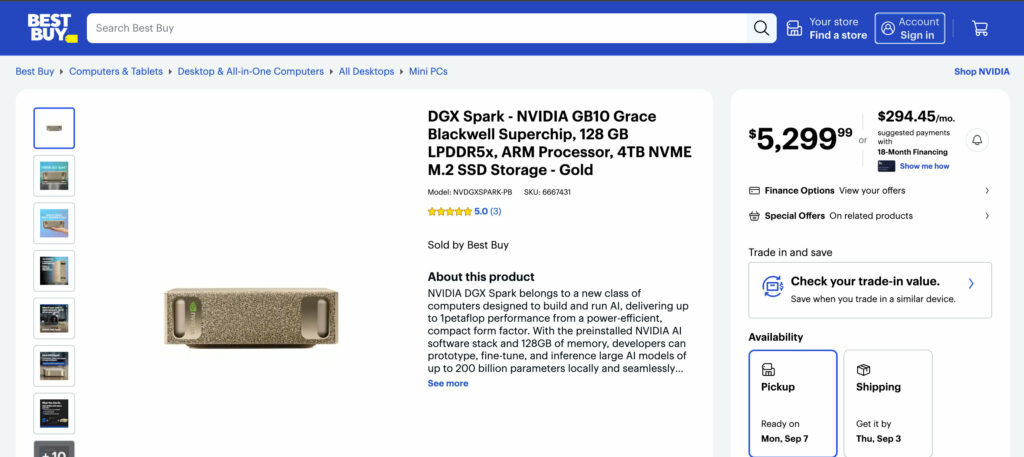
In February of this year, NVIDIA raised the price of the DGX Spark from $3,999 to $4,699. Of course, you can’t actually buy a Spark for $4,699. The actual price that I could find on Best Buy’s website was $5,299.
The Spark is a small computer, roughly the size of a hardcover book, designed to run AI models locally, rather than in a data center. In one announcement, they added $700 to the price. The product got no upgrades. There wasn’t a specification increase. They simply announced in the style of Marlo Stanfield, “The price of the brick is going up.” (See that double entendre there, because it looks like a brick? Look at me go.) NVIDIA attributed the increase to the cost of memory and storage.
Am I the only one who understands how weird this is? Consumer computing hardware does not get more expensive ever. That is not a trend. It is not something that has ever happened, and for some reason it’s happening right now, and we’re all just accepting it. Here’s how computing hardware has always worked: It gets cheaper. The fact that the price of hardware is going up should tell us that there is something fundamentally broken about the structure of what we’re witnessing. I think this story should have been treated as news, but it wasn’t.
Part 2: The agreed upon version of events.
Over the past four years, we have all agreed upon this version of events. I’m guilty too, so I’m indicting myself in this same statement.
Around 2022, a technological breakthrough occurred in software. Large language models crossed the threshold of usefulness, and a brand new industry formed around them almost instantaneously. That industry is the software industry, and the software industry is dominated by American companies, both large and small. In the software industry, our progress is measured in model releases. Enormous amounts of capital flowed toward the companies building the models and then companies building tools on top of the models because that is where we believe value is going to accrue.
That line of thinking is totally defensible, by the way. However, it is a selective way of thinking about the problem. I think it’s selective because this type of software we’re talking about, large language models, has a new way of presenting itself to the market. I may break your brain with this one, but not only are large language models changing how software is built, but large language models are changing how software can be delivered.
Along with being a life-long software engineer, I’m a life-long nerd and student of history. I probably owe this to my uncle John and late nights playing Axis and Allies at his house in Athens, Georgia. It makes people want to dive into the history of things when history feels real. The history that I’m thinking of is that people study not what happened, but how societies decide to remember what happened. The most consistent thing about studying history is that the choice of historical narrative is rarely an accident, and it’s usually never a mistake. People choose a comfortable narrative, and the comfortable narrative will usually be flattering to the people who are choosing to write the narrative. When we say that the winners write the history books, what we usually mean is: the winners get to portray themselves in the most flattering narrative possible. The narrative that wins is typically the one that has the lowest cognitive load in order to be believable.
Before I wander any deeper into this territory, I want to make sure I’m framing this correctly because the historians that I’m borrowing from talked about things like slavery and war and how lies followed for an entire century… and I’m writing about the cost of computer parts.
Suffice to say, slavery and RAM prices are not comparable.
What is comparable is the mechanism, and how we think about things. So what I want you to think about right now is what the software story allows us to conveniently avoid.
if artificial intelligence is a software revolution, then America will win because America writes the software.
However, if it is an industrial capacity problem, then America has a serious and humiliating problem because we spent the past 50 years deciding manufacturing physical things was somebody else’s job. The software narrative can be funded on venture capital timelines. You fund a Series B, you get 18 months, and you are now giving American Capital the narrative and the story that it is comfortable telling. The industrial manufacturing narrative requires state capital deployed over a decade, which is a thing that Americans have told ourselves that we don’t do. The software story has heroes that we know how to frame. Titans of tech who produce software have become household names. We do not have industrial heroes. We do not have manufacturing heroes. Manufacturing means boring shit, like zoning hearings. We don’t like boring shit.
So when the artificial intelligence revolution arrived, we told ourselves the software story. This wasn’t a conspiracy. It was just the cheapest possible narrative to believe because everyone already bought into the story that Americans were good at software.
Part 3: Let the record show…
Artificial intelligence in 2026 has a physical constraint. It’s well documented. It’s not interesting. We decided the subject isn’t interesting for reasons I can’t quite fathom. But we’re all experiencing this physical constraint.
It’s called memory.
There are three types of memory you need to understand, and you don’t want to confuse them because they are different things.
The first kind of memory is called LPDDR5X. This is the unified memory in machines people are actually buying to run large language models at home or for a small office. The NVIDIA DGX Spark has 128 GB of this specific type of memory. It runs at a speed of about 273 GB/s. That number may or may not mean anything to you, but I’m just putting it there in case it does mean something to you.
The second kind of memory is called GDDR, which is what sits around the graphics processor of my gaming GPU. I have an RTX 3080 that I purchased several years ago because I like pretending I’m a cowboy and playing Red Dead Redemption 2. Being able to hit 120 frames per second with all the settings set to high or ultra on a 4K TV is a religious experience. Also, Red Dead Redemption 2 is the most underrated video game of all time. It’s almost ten years old now, and it is still as visually stunning as a modern video game. Also, since we’re talking about narratives, the reason the game is dope is because it also has one of the best narratives of all time. This ends my small rant about Red Dead Redemption 2.
The third and last type of memory is called HBM for high-bandwidth memory. This is what’s going on inside of data centers. High-bandwidth memory is made by stacking memory dies vertically and connecting them through the silicon itself. It is difficult to manufacture because you’re not just fighting the failure rate of one component. You are fighting the compounded failure rates of all the stacks. HBM is expensive to produce because a single bad layer ruins the entire package.
Now we need to introduce the cartel. I said cartel. I meant manufacturers. Cartels collaborate to fix prices, and these manufacturers would never do that, would they?
Samsung, SK Hynix, and Micron control north of 95 percent of global DRAM production. HBM is dramatically more profitable per wafer than ordinary memory. So all three of them reallocated. (Of course, I want to state very clearly here that I have no evidence that they communicated with each other to reallocate their manufacturing, because that would mean they are colluding, which is illegal. I’m not accusing them of doing anything illegal.) More than 80 percent of advanced capacity moved toward HBM and server DRAM. And by Micron’s own accounting, producing a gigabyte of HBM consumes roughly three times the wafer capacity of producing a gigabyte of conventional DRAM.
Every gigabyte of HBM that goes into a data center accelerator removes about three gigabytes of the ordinary memory that would otherwise go into a laptop, a phone, or the personal computer. The reason laptops and phones are getting more expensive is because they’re competing with data centers for RAM.
So that is why the Spark went up $700-1,200 depending on where you buy it. Not because HBM is hard, but because HBM consumed all the production capacity.
I think the downstream numbers are probably even worse than the ones that were making headlines. It’s not just whiny gamers who are complaining about the price of RAM, making gaming PCs unaffordable. Although I think they have a strong point. I am of the opinion that buying a gaming PC should be less expensive than a crippling cocaine addiction. But hey, maybe I’m just old-fashioned like that.
Conventional DRAM prices rose 95% quarter-over-quarter from Q1 to Q2 2026. TrendForce is projecting another 63% rise on top of that from Q2 to Q3. Memory has gone from 15% of a PC’s bill of materials to 35%. SK Hynix has no remaining capacity this year. They are sold out. Micron has exited the consumer memory business entirely. Because of all this, smartphone and PC shipments are both forecasted to shrink in 2026… which is insane during the largest technology boom in 20 years.
Think about this for a second. We are experiencing the biggest thing in tech since the internet. And right now, it is hard to get your hands on new physical devices. That’s fucking crazy, dawg.
But wait, there’s more! TrendForce estimates that DRAM and NAND together will account for 47% of cloud provider total capex in 2026. Their forecast also says that in 2027 it will be 68%.
If that sounds a little insane, it’s because it is. By next year, roughly two-thirds of what hyperscalers are spending money on will be memory purchases, and this is at the largest price spike in the history of memory. This component has never cost more money, and they are buying more of it than ever before.
We are not describing the software industry, and we haven’t been for a very long time. We just keep describing this like a software problem. This is not a software problem.
Part 4: I’m not wrong, and if I stop shouting, it means I lost the argument.
With prices rising, risk exists if things get cheap. Everyone who is betting on the market right now is betting at a time when prices are at the highest. The capex gets you less value than ever before. Anyone throwing money at artificial intelligence today is getting the least bang for their buck for every dollar spent in the history of computing.
This is why literally no one has ever said, “buy high, sell low.”
The EVO-X2, a small form factor, desktop AI machine from a Shenzhen company called GMKtec, launched in 2025 at $1,999 with 64 gigabytes of memory. Its successor, the EVO-X3, launched in July of this year with the same processor and 128 gigabytes, at $3,600. A leak of the EVO-X5 just popped up on video cards with 192 GB of memory. Pricing has yet to be announced, but it is reasonable for someone to believe that it will be a better value than other desktop AI machines.
For American companies, this pricing represents precisely the wrong direction.
To my eyes, this looks like a supply constraint. The fix to a supply constraint is not clever. It is just slow. You build more fabs. There is no magical software workaround for an insufficient number of factories making memory. A memory fab is going to take somewhere between 18 and 24 months to construct, and then it will take many more months to yield in a predictable way. This means, under the best-case scenario, most of the time, from day one, affordable memory is something like 36 months.
If we assume that FAB started being built in 2025, then relief should have been on the way by 2028. Micron’s Idaho fab is slated to begin producing DRAM in 2027. SK Hynix’s Yongen cluster is targeting being in production in the second half of 2028.
Those are the projects that are on the American timeline.
There is another fab that was slated to be online in 2028, from Micron in Clay, New York. That timeline has now been pushed back to the third quarter of 2030. It turns out Americans are not good at building FABs quickly, and we can’t staff them very quickly either. There’s another one in New Albany, Idaho, that is operated by Intel, that was supposed to be open in 2026, and that is also moving to 2030. The Congressional Research Service report on the CHIPS Act had a mention of this, but almost nobody is reading Congressional research reports.
To quickly summarize, the Congressional Research Service said in the CHIPS Act (and I’m going to put it into crude layman’s terms here): “Hey guys, we might suck at building fabs, so don’t get too hopeful or optimistic about being able to be good at this quickly.”
The American timeline for producing domestic memory is not 2028. It is 2030 and later.
This doesn’t mean that my argument is wrong or that RAM is not still a pressing need for literally everyone who’s producing electronics. It means that my argument needs a new location.
Part 5: Ah yes, the Chinese.
There is this jingoistic way that Americans talk about China, and I’m not going to be doing that today. The way we grew up talking about China making the fun of them for cheap junk and knock-offs is a punchline that stopped being real around 1995. It is 2026, and China is an advanced manufacturing economy with serious research and development spending. Just look at what they did with cars. They did not build a cheaper car. They built a better car, and the only reason you don’t have one in your driveway and your neighbor’s driveway is the 100% tariff that is placed on Chinese cars. It has nothing to do with the deficiency of their engineering processes.
The other way that Americans talk about China is working under the assumption that they have already won. That’s also a lazy caricature because it assumes that Americans can’t do things.
Right now, CXMT is China’s leading memory manufacturer, and they are already doing huge volume in DDR5 and LPDDR5. Currently, ASUS, Acer, Dell, and HP are evaluating their consumer memory as an alternate source of supply. This is not cheap knock-off memory. They are a qualified supplier, and they are capable of slotting in to American-designed products.
However, on the high-bandwidth memory front, they are behind. CXMT is targeting mass production of HBM3 by the end of 2026. It should be noted that this schedule has repeatedly slipped, and so looking at Chinese press releases is not always the best way to gauge whether or not something is going to happen. Indeed, Chinese people are also capable of being a little too optimistic and perhaps fudging the numbers a bit. Additionally, they have no meaningful access to EUV lithography, which forces them into multi-patterning, which is worth it for both yield and cost. Meanwhile, manufacturers in Korea and Taiwan are already moving on to HBM4.
So if your question to this is, “Will China win the high-bandwidth memory battle this year?”The answer is no.
BUT.
I also think that that’s the wrong question. CXMT is reportedly reallocating around 60,000 wafers per month, which is roughly 20% of their 300,000 wafer monthly capacity, and putting it towards HBM. XMC, YMTC, and the packaging firm JCET are all working to localize the rest of their supply chain. China does not need to beat SK Hynix at manufacturing HBM4. The goal of the Chinese manufacturers is to produce enough “average” memory that the price for the higher-end products breaks their direction. I’m talking about commodity-level DRAM and LPDDR. This is the consumer-level stuff that’s going in desktop small-form-factor PCs.
Now that you understand all those things, let’s juxtapose it with the American timeline. Domestic memory capacity will be arriving sometime around 2030. Chinese capacity is being installed right now. That is a four-year window in which another country is going to set the world price for memory, and the United States is not part of that schedule. We didn’t lose the fight. We didn’t get out-punched. We weren’t even in the fucking building.
Part 6: Relax it’s only a prototype.
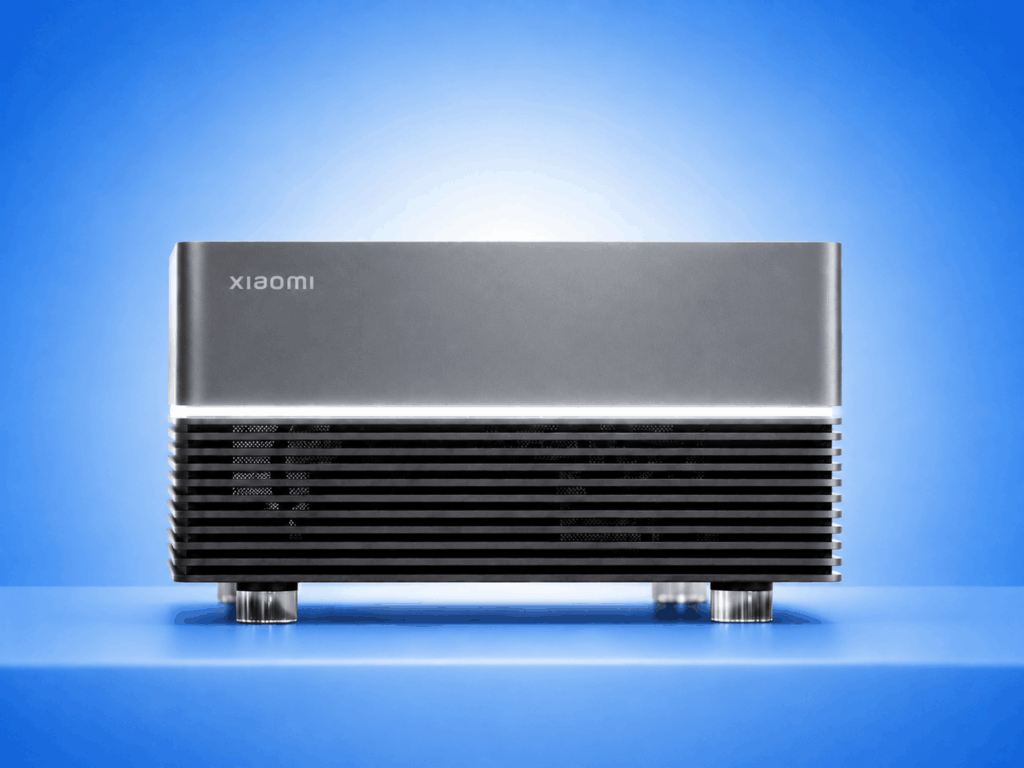
In August, at Xiaomi’s chip conference, Lei Jun showed something called the AI Cube.
I want to make sure you understand what the AI Cube is, and what it’s not. There is no price, there is no release date, and the AI chips inside it are slated for launch in 2027. I ran the Mandarin through a translator, and it literally just says “prototype”. This is an engineering prototype. It is meant to be a splashy announcement. What it means is they’re going to make this thing. They just haven’t figured out what it’s going to be yet.
Making an announcement is different than making a thing. With that said, the bill of materials to make that thing does exist. This is the Xring family of processors. The XRing O3 is the main processor. It gets a 10 CPU core, 16 GPU core, and a 200 TOPS Neural Unit. The O100 is a 6 nm part using 3D wafer-level stacked packaging with claims of up to 1.22 TB/s of near-memory bandwidth. The D100 is a 3nm chip with 20 CPU cores and 16 neural cores, supporting up to 160 GB of unified memory and local deployment of models up to 200 billion parameters.
For comparison, the DGX Spark you can buy today offers 128 GB of memory and the same 200 billion parameter ceiling for $4,699.
The thing that I feel like all the naysayers are missing about this device is perhaps the most obvious thing about this device.
This device already exists.
No, not exactly this device, but this device as a concept is not new. The Chinese mini PC already exists. GMKtec is a company that is headquartered in Shenzhen. So is Minisforum. So is Beelink. I have a small form factor PC on my desk right now. I don’t even know what fucking brand it is, but I guarantee you it is made in China. China has owned this entire product category for years. If you have shopped for a small form factor computer in the past decade, you have already been shopping Chinese manufacturers.
One big difference here is that China did not own the silicon inside. That still belonged to AMD or Intel or Nvidia.
The X-ring is going to close the last gap in their stack. They will have the chassis, assembly, memory, and processors. If Xiaomi can nail this back flip (and there’s no reason they can’t, because they’re already making cars), then every layer of this new mini PC is domestically produced in China.
The fact that Xiaomi announced a prototype is not the thing that is important here. What they announced was that X-ring processor, and we know that China is now making their own memory. This means that China is now fully vertically integrated.
This section got a little long, so I’m going to briefly summarize what all this means. You know all those OpenWeek models from DeepSeek and Qwen that are currently beating American Frontier models and benchmarks? People keep asking, “Why would China give away frontier models? This doesn’t make any sense.”
It makes a lot more sense if you understand China’s business model is different than our business model. China is a manufacturing economy. They want to sell you a physical thing. In order to sell you a physical thing, the thing that goes inside that physical thing must be free, and it must not have a subscription. China’s approach to cornering this market is they would like to sell you an AI box that sits on your desk for $2,000. The AI that goes inside that box is your choice. But whatever choice you make, it’s going to be free. Because they want to sell you the box because they make money making the thing.
China is a manufacturing economy, and their goal is to manufacture their way into AI dominance.
The United States is not a manufacturing economy, and the only thing we can offer is data centers and subscriptions. We simply do not have the ability to put an AI box on your desk. We don’t have the vertical integration, not even close.
And what I’m here to tell you is that I think for most business use cases, China is currently producing the better outcome.
Part 7: Why does anyone want this “AI box” anyway?
I already know what the argument’s gonna be here. “But Shane, why not just pay $20 a month to ChatGPT or Anthropic for a subscription?”
I want to keep it 100% clear about who’s actually buying these machines because the answer is not going to be hobbyists. Enterprise use cases in business are actually what fuel the tech industry. IBM did not build a business around Tom, Dick, and Jane’s consumer hardware. IBM is called International Business Machines for a reason.
Consider an American law office with three to five partners. They would like a system that performs document abstraction, organizes their case scheduling, and produces first drafts of briefs. Every single one of those tasks touches privileged client material that they would prefer not to transmit to a third party. I’m not 100% clear on the ethics or legal obligations behind this, but I’m pretty sure that sending privileged material to a third party would be a pretty big breach of confidentiality.
What I’m saying is those tasks can be done, and they’re tedious but not difficult. And “tedious but not difficult” is what these multi-agent systems do extremely well.
The standard objection to this line of thinking is that local models are slower, and this objection is correct. A DGX Spark moves at 273 GB/s. A comparable high-end gaming GPU will get you nearly 2,000 GB/s. You will get meaningfully fewer tokens per second on a DGX Spark than you will on a dedicated GPU.
To which I say: So the fuck what?
If an agent takes 12 minutes to produce a 60-page brief that a partner is going to read line by line anyway, that’s fine. Nobody is holding a stopwatch waiting for this agent to get done with its work. Not every single interaction you have with a large language model needs to feel like a chat window. Yes, I understand chat windows are how we were introduced to this technology, but there is an enormous category of professional work where the expectation is not bound by the time of a chat window.
The reason I know this is because I’m building one of these systems right now. A friend of mine owns a barbecue restaurant and bar here in Alexandria, and we are building a multi-agent system to handle: inventory, vendor ordering, scheduling, catering tasks, dynamic menus, TV schedules for football games, etc. The economics work for a very specific reason, and that is the onboarding cost is roughly the cost of the hardware. After buying the machine once, you own the compute. There is no per-token bill that scales with how much you use the thing you bought.
For a business with 15 employees, the return on investment for this $5,000 capital purchase makes a lot of sense. The same math works for a dental practice, a roofing contractor, or really any other small business that has tedious and time-consuming tasks, which is to say most small businesses.
The one caveat I’ll make is the “me factor”. The ecosystem of software is nowhere near ready for people like my friend who owns the barbecue restaurant and bar. It still requires a person like me to build the software and customize it to a business. This is why I’m not worried about job security. Standing this thing up today requires: Asking questions about how his restaurant needs to interact with different components, configuring a Postgres database with a vector extension like pgvector, building an ETL pipeline, managing the network layer, etc. The thing I’m describing is me. It’s a combination of cloud architecture and cybersecurity and software development. What it does not describe as the owner of a barbecue restaurant. I love my guy CJ to death, but he’s not a software engineer.
So the gap is definitely there, and the gap is actually getting wider because the hardware is arriving faster than the software. Software engineers are trying to close that gap, and I think it will be good for business. I just wish that gap was being addressed the same way we talk about how frontier models are hitting benchmarks.
I’m also not saying that the hardware argument means data centers are going away. Enterprise compute is a thing that actually fits really well in cloud environments. Businesses need redundancy, elasticity, compliance, and uptime guarantees. If you are running a bank, you are not putting your computer on a bookshelf that doesn’t have a battery backup. My claim is that this small form factor of compute means that a new type of vertical can exist that did not exist before. The reason it didn’t exist before is because… it didn’t exist. (Yes, I know I just ended a definition with a definition, but that’s the whole point.)
Part 8: “Back in my day, computers use to cost $8,000.” We know. Thanks Grandpa.
Everyone who is currently arguing about whether or not artificial intelligence is a bubble is arguing about whether the technology works. That is the wrong axis to think about this argument. There is no doubt the technology works. That was not the risk. The risk is that it gets cheap.
Flying from New York to London in the mid-1940s ran around $600, roughly $7,000 in today’s money, and that was effectively first class because coach barely existed yet. By the early 1960s it was still about $600, call it $5,800 adjusted. Today that route runs $400 to $600 round trip on a budget carrier, and we complain about the legroom.
The first countertop microwave, the Amana Radarange in 1967, cost $495, about $5,000 today. RCA’s first color television in 1954 was $1,000, roughly $12,000 adjusted, and some competing sets cost even more. My family bought a personal computer in 1996 for $3,000, which is about $6,100 now.
Yes, it’s possible to buy a personal computer for $6,100 today, but realistically, you’re gonna get all the computer you need with a MacBook Air for around $1,500.
What I mean to say is this: every single one of these items followed an identical curve. It was expensive.
Manufacturing infrastructure was built, or supply chain infrastructure was built. Then it became cheap. Then it became ubiquitous. Then it became a thing that we don’t really think about as a commodity.
When technology becomes something you don’t think about, it becomes somewhat invisible. I probably use my microwave several times a day, and it is essentially invisible to me as something that was once bleeding-edge technology. No one who comes over to my house should be impressed that I have a microwave.
So how does this line of thinking kill a bubble?
Let’s think about fiber optics in 1999. Many companies made huge amounts of investments into fiber optics. The technology is absolutely real, and we still use it today. The Internet did in fact become the biggest thing in the world, exactly as we were promised. And the internet arrived on basically the schedule we were promised. But all the companies that invested in fiber optic technology — they all lost their asses. That’s because everyone was investing in fiber at exactly the same time. The capacity arrived all at once. The price per unit for bandwidth collapsed, and the revenue models that justified the capex behind fiber optic investment completely evaporated.
Their thesis was right, but because they bought at the top of the market, the trade-off was wrong.
Confusing software limitations with hardware limitations has cost a great deal of money for many people more than once.
This brings me back to that 68% figure that I cited above. If two-thirds of hyperscaler capex in 2027 is memory being purchased at peak prices, and if at the same time Chinese capacity arrives in that four-year window while American capacity slides, then an enormous amount of infrastructure is being financed on the assumption that scarcity is permanent.
Plot Twist: Scarcity is never permanent. Scarcity is related to a construction schedule.
Part 9: This is about us.
What could the United States have done differently not to be in this predicament? I’m trying to be fair to my own country here because I have this vague sense of patriotism, but also I’d like to be on the winning side of this. Winning is objectively better than losing. I know this because I’m a Dallas Cowboys fan, and I know what it’s like to experience profound sadness for thirty years!
We have done industrial policy. The CHIPS and Science Act, signed in August of 2022, committed roughly $53 billion to manufacturing microchips. About $40 billion of it was direct manufacturing incentives, and a 35% investment tax credit. That’s not nothing. It is a large and deliberate instrument of government trying to intervene in scientific research and development.
It’s also not nearly enough.
This, despite our government going considerably further than most people even realize. Intel got $8.9 billion, and also the United States government got a 9.9% equity stake in Intel, making the United States government the single largest shareholder of Intel. We also have an option to buy another 5% of Intel if the company ever drops below majority ownership of its foundry business.
So yes, we did invest, but we invested in the wrong type of technology. We funded CPUs. We didn’t fund memory. CPUs are advanced nodes and leading-edge processors, which is the glamorous end of the industry where American companies already had a story. Intel and AMD have led the CPU business since its inception.
What we needed was memory, not CPUs.
While we were funding CPU production, the binding constraint on the entire industry turned out to be memory. And when we didn’t fund memory, the schedule started slipping. Idaho moved to 2027. New York moved to the third quarter of 2030. Most importantly the tax credit for any project that has not broken ground, will expire on December 31st of 2026.
Americans are not bystanders in this car crash. We are definitely behind the wheel. Our hands are on the wheel, our foot is on the gas and the brake simultaneously. We are crashing, and it is our own fault.
We didn’t fail to do something. We just failed to do the right thing. We took aim at the wrong part of the problem. Why did we do it? Because when Americans invest in tech, we invest in the stories we understand, and those stories tended to be Team Red and Team Blue — the double entendre, again, is not lost on me there. (If you don’t already understand the reference, AMD has a red logo and Intel has a blue logo. In the CPU competition, releases from AMD and Intel were often referred to as Team Red and Team Blue, and then NVIDIA became Team Green. However, it does work as a political reference, which is why I left it in there. I realized I was going to need to explain the joke and double entendre because most of you are not super nerdy gaming PC builders.) For the longest time, CPU benchmarks were what mattered. This is how gamers would look at their decision-making for building a new PC. Indeed, we thought about the memory in our GPUs, but we weren’t thinking about why the memory mattered in the GPUs unless it pertained to high end graphics, 4K gaming, and frame rate.
if you left me in charge to write the policy, it would be these three things:
Thing number one: Build memory fabs, not CPU fabs.
I don’t care how you frame it, and I don’t care how it gets funded. You can say it’s for economic security or national security, or the plain fact that the Department of Defense has no sovereign supply chain for the single most critical component in modern warfighting. I work in that sector, and the absence of this conversation is genuinely difficult to wrap my head around.
Thing number two: Build power, which means nuclear. There will always be a data center tier, and it will always need electricity that does not overpower the grid. Building nuclear power satisfies the always-on demand of data centers, as well as being carbon-free, which is something that satisfies the demands of environmentalists.
Thing three: Fund the fuck out of universities because the people who will solve the next generation of lithography are 13 years old right now, and we need to make sure that we have the top talent in this industry.
Part 10: Stop saying no one could see this coming. We all saw it coming.
You know those people who say, “No one could have seen this coming”?
Those people are fucking morons.
The physical supply chain constraints were visible. It was always in the earnings calls and the price sheets for these publicly traded companies. There were no surprises here. Anyone who has spent any amount of time building PCs for playing video games can tell you the volatility of these prices. I’m not trying to say that playing Hearts of Iron 4 was done out of some sense of patriotism or understanding PC part pricing. But I am saying, because I play Hearts of Iron 4, that I understand exactly what the cost of RAM has been for the past 20 years.
When I looked at the Congressional Research Service report, I saw the same thing there that I knew as someone who had built PCs. This was a hardware problem wearing a software costume. We have been through GPU shortages before when bitcoin mining blew up. This was not an exotic problem.
What we did as we looked at the problem was we saw what we wanted to see, because seeing the other thing would have required admitting that the decisive advantage for the most important technology of the century might belong to another country who was willing to build factories. The other uncomfortable truth here is that country isn’t us. We have not meaningfully invested in American high-tech manufacturing, and we’re falling behind every single day.
So is the bubble gonna pop? No. But it’s going to deflate very slowly. That deflation will happen as more memory arrives on the market. It will be less jarring to the economy than this singular momentous pop, but it will be no less damaging. I dated this girl one time who had a breast implant that started leaking. It didn’t pop all at once. It was a slow leak, but the damage was still there. The problem, like the United States and China, is that this battle gets a little lopsided, like a single titty deflating while the other one isn’t.
If you’re financing scarcity and your opponent can be ruined by abundance, then the market advantage is with the entity that can manufacture abundance.
When the history of how this story is written, I don’t think that it’s going to be the splashy announcements from Sam Altman that get covered. The thing we’re going to be talking about in the history books is that Xiaomi $1,000 desktop AI PC and pricing that deflated the American market.
With all that said, I genuinely hope I’m wrong about this, because if I’m right, the American economy will probably take a hit that consumes about 30% of the tech sector.