
On August 10th, Mark Zuckerberg published a 6,500-word essay called “The Future is for Everyone.” I think I speak for everyone who read all 6,500 words when I say, “Holy shitballs that dude is completely disconnected from reality.” I have read a lot of summaries of the essay, and I’m wondering if, perhaps, I was the only person who actually read it — rather than feeding it into Claude or ChatGPT and asking for a summary. Because if you read it, the takeaway is actually a lot simpler than any topic about superintelligence, artificial intelligence, human-machine assistance, or… anything about technology, really.
This is an essay that really demonstrates just how disconnected a titan of tech has become from the real world the rest of us are currently raw-dogging every day.
So, uh… what does he say?
The essay is Zuckerberg’s philosophy for the age of superintelligence. He talks about personal agents, the ability to invent new things, how superintelligence balances power across the world, and also this anecdote about his eight-year-old daughter building a robot. (We’ll get back to this in a moment, because it’s supposed to be a sweet anecdote about a father and his daughter, and it ends up being more dystopian and creepy.)
After reading the whole thing, I kept thinking about a book called “More Everything Forever,” which is about how tech billionaires have essentially confused science fiction novels with municipal planning documents. I thought about this book, because that’s what this Zuckerberg is explaining in his essay. It’s a disconnected billionaire describing the plot of a science fiction novel, and calling it a roadmap to our shared future. And it’s deeply fucking weird.
Those science fiction books were… works of fiction that were meant to be entertaining. They were put on a shelf in bookstores and libraries called “Fiction” for a reason.
Part 1: Goddamnit, it’s a fucking cake, Mark.
I’ll give you the most reasonable take I can (*at least to begin), because most people are just dunking on Zuckerberg. I don’t want to be charitable to this out-of-touch dickhead, but he’s still a human being with feelings*. (Allegedly.)
Zuckerberg’s thesis is that superintelligence is coming, and the only question is whether it gets centralized in a few institutions or distributed to everyone. He wants to distribute it, because he doesn’t have a firm grasp on irony or self-awareness. In Mark Zuckerberg’s science fiction novel of our future, everyone gets a personal superintelligent agent that works 24/7 on your relationships, your health, your career, your finances, and your hobbies. Everyone gets a tutor with a PhD in every subject. Everyone gets invention superpowers. The economy becomes more entrepreneurial. Small teams run huge companies. Science accelerates. A large salami walks by a store that says “Cured Meats”, and a tear falls down the salami’s eye.
To which I say, this is all fine, I guess. As a guy who builds software for a living, parts of his thesis are technically real. I will say the tools are getting better, and I can say this because I use them every day. I like Muse, and Spark 1.2 for coding assistants. I wrote about this last week.
But when you dive into the details, that’s when Zuckerberg’s entire thesis turns into this bizarro world, anthropological nonsense. He describes his own personal agent monitoring his sleep, and watching him exercise, and giving him feedback on workouts. He wants an agent that plans personalized baking recipes for him and his daughter every weekend. The agent will order the ingredients for the baking recipes and also offer suggestions on what they should bake.
Pause.
I say this as an engineer: Life is not meant to be engineered.
I have three kids, and so I understand the father-daughter activities that he’s describing. In Zuckerberg’s world, a machine is planning your father-daughter activities, and a machine is procuring the supplies for your father-daughter activities. Then a machine supervises your father-daughter activities. At no point in this father-daughter baking activity would I describe any of these activities as “the actual fucking important part of spending time with your daughter.” The entire point of baking with your kids is that it’s messy and fun. You get to go to the grocery store and pick different boxes and figure out what frosting you want. Then you’re going to come home and you’re going to make a mess. That’s the fun part. I’m not trying to optimize my yellow cake recipe with the help of a four year old. I’m trying to experience a real fun human activity with my children. Part of the magic is… your kids not being good at cracking eggs, and laughing while you try and pick the eggshells out of the batter together.
You can read the entire essay if you want, but if I had to boil the entire essay down into an idea, it’s that every single example that Mark Zuckerberg has in his essay is just like this: A thing we did was already fine and fun and uniquely human, but Mark Zuckerberg would like to insert a machine into that experience.
Mark Zuckerberg has no goddamn idea what it’s like to be a functional human being. Believe it or not, some of us would like to experience joy, and not optimization.
Part 2: Maslow would like a word with you, Mark.
You might remember this from 10th grade, and you might not. It’s fine. It’s called Maslow’s Hierarchy of Needs. It’s a visual pyramid for how human beings exist and potentially thrive. At the bottom, we have the stuff that you need to survive. That’s food, shelter, and safety. In the middle of the pyramid, we have belonging, friendship, love, and joy. At the top, we have self-actualization, which is fancy shit like creative fulfillment, playing guitar, working on cars as a hobby, learning to paint, etc.
To understand the functionality of this pyramid, you have to understand that it’s something that must build upon itself. You cannot self-actualize your way out of a housing or shelter crisis. If you need $2,800 to repair your transmission on your car, you cannot self-actualize personal growth and remedy a transmission.
Absolutely none of Mark Zuckerberg’s essays covers the bottom or middle row of Maslow’s pyramid. Everything that Mark Zuckerberg covers is at the very tip top of the pyramid. This is the fun part of life, which I totally understand. Being able to express your ideas, pursue your interests, and reach your full potential as a human being is genuinely cool shit that we all should aspire to achieve. I want you to take up oil paints like Bob Ross, or get into photography, or learn to juggle dangerous flaming things, or become a DJ for your local music scene and make positive vibes happen at your local themed bar. Run an Ironman or a Tough Mudder. Join an adult softball league. Whatever, man. That shit is all the fun part of life.
The problem I have with Zuckerberg’s essay is that we can’t talk about what it’s like to live in the penthouse, surrounded by rap-video-girls spraying champagne on their tits, when the bottom floors of the building are on fire.
This is where Mark Zuckerberg and I have very different life experiences, and I’m going to speak to my life experiences. My life experience will probably more closely mirror your life experiences as well. I say this because I’m publishing this on my blog that perhaps thousands of people read at most, and Mark Zuckerberg has the megaphone of the entirety of Meta, so suffice to say, we have very different readerships and lifestyles.
Mostly importantly, I want to talk about what’s happening at the bottom of the pyramid because that’s the actual place where most people I talk to live. Housing costs are eating people’s entire paychecks. Child care costs more than college used to. Wages are stagnating. The cost of everything is going up. This isn’t just an American story. This is something that’s happening across most OECD nations. No one in my social circle is lying awake at night, looking at the ceiling of their bedroom, and thinking to themselves, “I really wish I had a PhD-level research assistant agent with unlimited patience.”
They’re lying in bed at night awake because they’re trying to figure out the math behind their mortgage, because their transmission failed, and they have a major expense that they can’t navigate. They’re trying to figure out how to afford braces for their kid, and their car payment at the same time. No one, and I do mean absolutely fucking no one, is thinking about a PhD-level agent that lives by their side like that weird in-ear assistant from the movie “Her” with Joaquin Phoenix. (Which, by the way, was crazy prophetic.)
What I mean to say is no amount of talking to robotic superintelligent agents is going to change the lives of middle-class Americans, and people living in poverty.
Mark Zuckerberg is trying to solve the kinds of problems that people only get to solve after they’ve become extremely wealthy. The reason that Mark Zuckerberg is skipping levels is because, for him and his world, those levels don’t exist. There has not been a single time in his adult life where he’s looked at a grocery store receipt and understood what it meant to look at the receipt. The bottom row of Maslow’s pyramid is invisible to him, the same way that water is invisible to fish, except weirdly reversed. Mark Zuckerberg is a fish who is telling other fish that they don’t need water.
Part 3: Can someone please explain this to Mark in the group chat?
So how does this essay even happen? Mark Zuckerberg is a genuinely smart person, and yet he wrote something that is so detached that it’s hard to even put into words. Here is my theory, and I mean it literally.
Mark Zuckerberg does not have a group chat.
Literally. I don’t think there’s a group of friends that hold Mark Zuckerberg accountable the way a group chat does. I would assume he has WhatsApp, because he owns it. Yet, I’m also willing to be that the way he uses WhatsApp is not the way everyone else uses any group chat application. Most of us, as adults, now have several group chats that we’re part of. We talk a lot about people being anti-social because of modern social media, but I actually think group chats are a productive novelty in this modern “everyone’s staring into their screen” era. At least we’re trying to remain some semblance of socially aware friendships. Group chats do that.
These peers are important because, for people who have power and influence, a group chat can be a group of your peers and friends who knew you before you were rich and famous. Ideally, these are people with no financial relationship with you, and their entire function in your life should be friendship. These people have the liberty to tell you you’re being an idiot without fear of some financial, political, or other unknown repercussions.
The most normal grounded people have at least one or two group chats of peers who keep them normal. Personally, I’ve got a group chat for my business partners, which tends to be 40% juvenile humor and memes. I have a group chat for Cars and Coffee. I have a big professional group chat that is basically just people talking shit about federal contracting. I have three fantasy football group chats. I have one for just people that I knew through my early life in my 20s in Nashville. I have a group chat for people who build software.
Group chats are useful because it allows us to be vulnerable sometimes, silly sometimes, and talk about parenting sometimes… It’s a place where you can metaphorically “wander” socially. If you’re an introvert, you can just hang out in the group chat and know that if you wanted to, you totally could talk to people. (But you won’t. Just know that you could.)
The most important part of a group chat is that it keeps you tethered to what regular life costs and feels like. This is especially true for people who have money, power, and influence. It’s a place where people can mock you and make fun of you in a good-natured way. A group chat will keep you real.
Suffice to say, I don’t think Mark Zuckerberg has ever been in a group chat. He became a hundred-millionaire in his early twenties and a billionaire shortly after that. Mark Zuckerberg has been accelerating away from Earth since his early twenties. The same is true for other people who are completely out of touch with reality, like Elon Musk, Jeff Bezos, and Sam Altman. Every person who could have been in their group chat is now an employee, an investor, a rival, or a sycophantic suck-up.
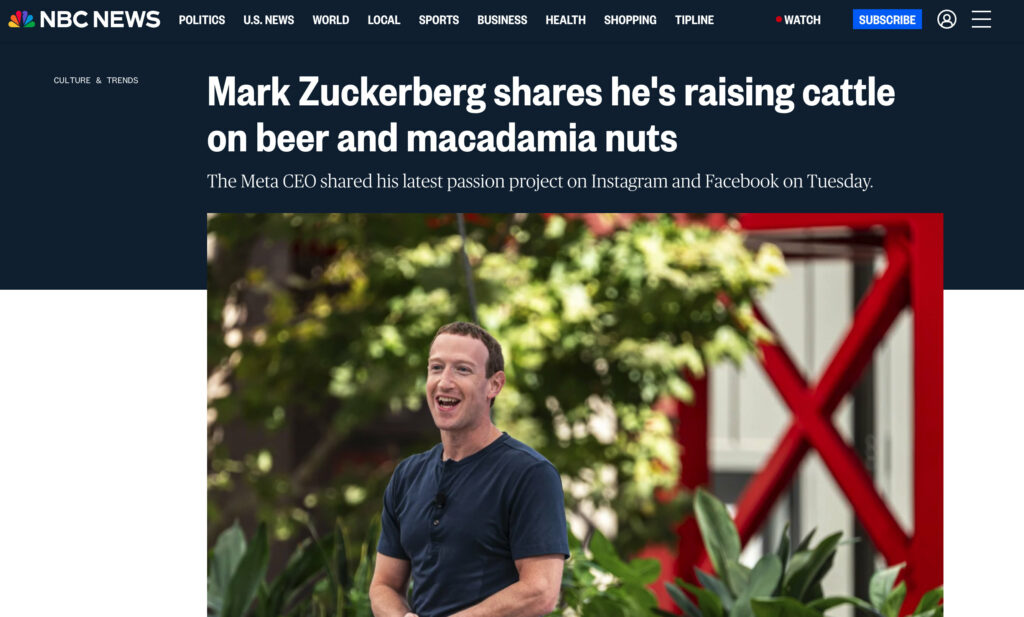
Why do I know this is the case? Because Mark Zuckerberg bought a massive ranch in Hawaii. Hawaii is a place not typically known for cattle farming because the land is incredibly expensive. On this farm, Mark Zuckerberg grows cattle, and he feeds them macadamia nuts and beer. This is not exactly a cheap diet for cattle. When I say that it is nearly impossible for you to connect to normal people, I don’t mean it in this abstract way where billionaires are automatically disconnected from working-class people. What I mean is, when you get to the point where you’re buying the most expensive land in the world to start a cattle farm so you can feed them a diet of macadamia nuts and beer, you are no longer living a life that the rest of us can even conceptualize. It also takes a special type of disconnect to think that you are the kind of person who can create tools for normal people to help them live their lives in a more complete way.
When you become that wealthy and powerful, nobody in your orbit is allowed to say, “Hold up, dude. What the fuck are you doing?” — without it being a career decision. That’s a problem.
It’s a destructive positive feedback loop because the more money they get, the more disconnected they get. And the more disconnected they get, the less they can relate to someone whose “big dream” is just an affordable fixed-rate mortgage. It’s a positive feedback loop that has no brakes. That’s how somebody like Mark Zuckerberg ends up publishing a 6,500-word essay about super intelligent agents, while the average American is Googling, “How long can you drive on a spare tire?”
To be clear, it’s not just Mark Zuckerberg. It’s all of these tech bro billionaires. They continually say shit that sounds absolutely crazy, but I don’t think it’s because they’re crazy. I think it’s because there is no one left in their social circle whose function is to clock them in the group chat and tell them they’re crazy.
Part 4: It’s a science fiction book, damnit.
I started this talking about Mark Zuckerberg, but I don’t want to make it all about Mark Zuckerberg, because that’s unfair to him and also doesn’t correctly analyze the scope of our problem. This is the whole issue about what I will call the “genre” of billionaires.
Elon Musk wants to put people on Mars. I don’t want to put people on Mars. I want to put people in houses. I’m not saying that to be a dick. I’m saying that because it’s an actual policy position that improves people’s lives. I love space exploration. My wife works at NASA. Space exploration is legitimately cool.
But I can also recognize the optics of what we’re talking about here.
One of these things costs hundreds of billions of dollars, produces no economic output, and involves a destination where human beings cannot survive.
The other one is a home. A place where, notably, human beings can survive, and potentially just have a middle class life they enjoy.
Have you even heard some of the insane shit that Elon Musk talks about? He talks about terraforming Mars. No offense, dude, but we already have a planet that we evolved over millions of years to live on successfully. This motherfucker comes pre-terraformed. It has things that are essential to us, like air and liquid water and food we can grow. Earth is genuinely fucking sick, and we should strive to maintain it.
To put it in software terms, the “proof of concept” for maintaining a species on a planet… is first maintaining our species on this planet. Currently, (to use a video game metaphor, which I know Elon Musk will enjoy) we are failing the tutorial level on Earth. We don’t need to up the difficulty level when we’re already failing easy-mode on Earth. We’re failing to manage our own ecology on Earth. The idea that somehow we’re going to nail it on a frozen, irradiated rock, 140 million miles away, is not Elon Musk being an ambitious visionary. It is the delusional rambling of a borderline trillionaire who doesn’t connect with other human beings in a meaningful way.
This is the same argument that I give to people who want to talk about flying cars. I don’t want flying cars. Do you know why I don’t want flying cars? I watch YouTube videos about air traffic control and airplanes. Air traffic control is already one of the most stressful jobs in America, and that’s with trained professionals and trained pilots working harmoniously to keep everything in the air. There is no reality where I want to hand a third dimension of public travel to people who have shown they can’t successfully merge into highway traffic. I have watched some of you motherfuckers handle roundabouts. You ain’t piloting a fucking flying car. Get the fuck out of here.
Anyway, I digress…
Nobody, and I mean fucking nobody, is demanding all this bleeding-edge tech that the billionaire class is talking about. Focus groups are not producing these ideas. If you talk to normal everyday middle-class people about what they want, the answers are embarrassing, in the sense that they are just boring. They want to be able to afford their student loans. They want a slightly better, slightly higher-paying job. They want child care that isn’t effectively a second mortgage payment. For the people who don’t have a mortgage, they just want mortgage rates to be affordable. They want a car payment they can afford. They want to go to the grocery store and not be anxious. People want to be able to make smoothies without it being a big financial decision.
This is stupid, unglamorous, middle-class minutiae.
And we’re not even delivering the basics. It’s that middle row and bottom row in the pyramid shit. We can’t even get that right.
Part 5: This part was actually sad.
There was a moment in this essay where I felt sadness for Mark Zuckerberg instead of just annoyance.
The unstated premise and thesis of this whole essay is that the future of your human life is going to directly interface with the machine. This superintelligent agent is going to improve your relationships. It’s going to be your tutor, your coach, your assistant, and this collaborative creative partner. Interaction with this superintelligent agent is the product that Mark Zuckerberg is describing.
This vision comes from the man who built Facebook, and Facebook is a product whose actual legacy is that it transformed “connecting people” into this slot machine-like experience. He then followed up this first vision of connecting people with his product, which he called the Metaverse, which is a multi-billion dollar bet that human beings wanted to strap screens onto their face and hang out as disembodied heads in an empty digital mall.
Real, actual malls are fun. Fake, digital malls that you strap to your face are not fun. I never thought I would write those two sentences, but here we are.
Mark Zuckerberg believes that people want a mediated substitute for actual human connection. These are the products that his company is producing. The market has also responded by saying, “Fuck no, this isn’t what we want.”
And I’m going to tell you why I know I’m right.
People don’t want to talk to robots. People want friends. That’s it. That’s the secret to life, boys and girls. People want to have a house that their friends can come over to. They want to sit on the patio and talk about sports and make brisket and complain about their jobs in person. They want to talk about their kids and their pets and watch a football game together.
I know this because I experienced this thing called actual human life.
I play in a Sunday evening softball league. It’s a bunch of dads, roughly my age, with varying levels of remaining athletic ability. Do we enjoy playing softball together? Yes. Would we like to win the game? Also, yes. But the real reason we go play softball is because we stand in the dugout together and talk about our kids and our lives. We crack jokes about each other being old and out of shape. There have been zero times that I’ve ever thought about needing an agent to optimize my swing. Softball is just a way for us to get together and experience human connection.
Human connection: That’s the product.
It has a five-star rating going back roughly 300,000 years.
I don’t want a robotic PhD super intelligent assistant always next to me. I want to experience a human life. I want to spend time with my friends and my family, and I want to do it without the stress and anxiety of my car’s engine wrecking my life financially when the N63 eventually blows up. (This technically won’t happen because I have my CarMax warranty, which I highly recommend, but for people who didn’t purchase the CarMax warranty, when their BMW does eventually explode, this will be financially devastating.)
Part 6: The most expensive car is cheap car.
I’ll end this with a metaphor about cars because I’m a car guy and a lot of my essays tend to be about car metaphors.
The most expensive car you will own is a cheap car. If you get something cheap, there’s a reason it’s cheap. Usually, the upfront costs tend to be outweighed by the ongoing maintenance and repairs. The United States, in our current state, and most of the other OECD world right now is a car that’s cheap up front, with a lot of ongoing maintenance and repairs.
With a cheap car, everything is breaking all the time. The windows will roll down and not roll back up, and then on that same day, it’ll pour rain. This rain will then get into your car and cause electrical problems, which cost even more money. The stress of things breaking will also take a toll on your mental health. When you need to go to the job interview, your car is going to break down, and you’re going to lose that opportunity. This cheap car will cost you opportunities in life. It will hold you back from doing the things you want to do.
Mark Zuckerberg is looking at this cheap, unreliable, glued togeher piece of shit, and his first thought is: “We’re putting a Ferrari V12 in this.”
The $150,000 crate-engine V12 is superintelligence. I don’t want to put a Ferrari V12 into this piece of shit. Because this piece of shit is not going to support housing, child care, fair wages, health care –basically the stuff you need for ordinary life.
Zuckerberg is standing there revving this beautiful Ferrari engine on an engine dyno, and it sounds incredible. As a car guy, I love what it could be. Listening to a Ferrari V12 sing is fucking awesome.
But none of it matters, because the car he’d like to put the Ferrari V12 into cannot make it down the road. Nobody gives a fuck about your Ferrari V12 when the entire chassis is just waiting to snap in half at the first pothole. Many people, myself included, are arguing that this piece of shit is not worth saving, and when we replace the piece of shit, we still don’t give a fuck about putting a Ferrari V12 in it.
The reason he thinks the Ferrari V12 is the answer is the same reason he thought it would be a good idea to start a cattle farm in Hawaii and feed them a diet of macadamia nuts and beer. Mark Zuckerberg has no idea what it costs to do anything. In a capitalist society, if you aren’t helping people get through what things cost, then every discussion you have after that doesn’t matter.
What most Americans want is something that would be closer to the metaphor of just a reliable Ford truck or a Honda midsize SUV that’ll get them 300,000 to 400,000 miles of usage. They want something that just gets them down the road.
And that’s my real conclusion here. Zuckerberg isn’t so much a villain as he is an exhibit of our insane economic outcomes. He is one of the strongest arguments that exists for taxing billionaires, not as punishment, but as a public safety measure. We have now run this experiment several times, and the results of the experiment are bleak. When you hand a human being a hundred billion dollars, and total insulation from any ordinary semblance of life, he loses his ability to understand what ordinary life needs. Mark Zuckerberg controls more capital than most nations, and he cannot figure out how to deploy that capital to improve a normal person’s grocery run. The reason he can’t improve anyone’s life is because, since about 2004, he has not touched a normal life.
So sure, Mark, the future is for everyone. The problem is everyone is still living on the ground floor, and the rent is due, and our kids are trying to enjoy daycare we can afford.